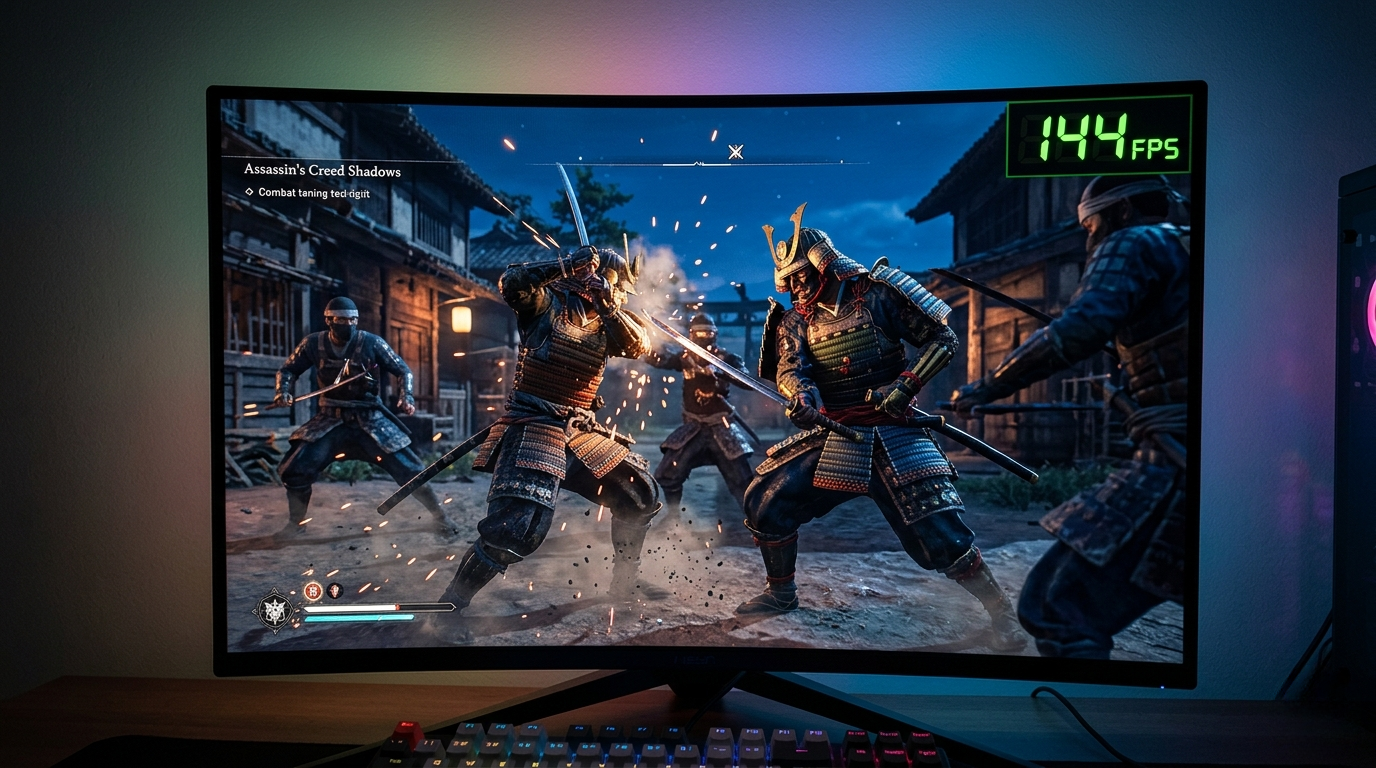

If you’ve been struggling to get smooth frame rates in Ubisoft’s latest open-world epic, you’re not alone. Assassin’s Creed Shadows is one of the most demanding PC titles of 2026, pushing even high-end rigs to their limits across its sprawling feudal Japan landscapes. Whether you’re running a budget build or a flagship GPU, this guide will walk you through every setting that matters — and exactly what to change to squeeze out every last frame.
Why Assassin’s Creed Shadows Is So Demanding
Shadows uses Ubisoft’s AnvilNext engine with full ray tracing support, highly detailed foliage rendering, and dynamic weather simulation across large open zones. On default “Ultra” settings, even an RTX 4080 can dip below 60 FPS in dense areas like Osaka. The good news is that the game has a wide range of scalable settings, and most of the visual quality is preserved even at aggressive optimizations.
Hardware Tier Expectations
Before diving into settings, it helps to know what FPS ceiling to realistically target based on your hardware.
Budget Tier (1080p)
- GPU: RTX 3060 / RX 6600 XT
- CPU: Ryzen 5 5600 / Core i5-12400
- RAM: 16GB DDR4
- Target FPS: 45–60 FPS at 1080p Medium settings
Mid-Range Tier (1080p–1440p)
- GPU: RTX 4070 / RX 7800 XT
- CPU: Ryzen 7 7700X / Core i7-13700K
- RAM: 32GB DDR5
- Target FPS: 60–90 FPS at 1440p High settings
High-End Tier (1440p–4K)
- GPU: RTX 5080 / RX 9900 XTX
- CPU: Ryzen 9 9950X / Core i9-14900K
- RAM: 32GB DDR5 6000MHz
- Target FPS: 90–144+ FPS at 1440p Ultra / 60+ at 4K
Not sure what FPS your rig should hit? Use the Assassin’s Creed Shadows FPS Calculator at fpscalculator.net to get a personalized estimate based on your exact CPU, GPU, and resolution before changing a single setting.
In-Game Graphics Settings — What to Change
This is where you’ll find the biggest performance gains. The settings below are tested and ranked by their performance impact.
Display Settings
- Resolution: Match your native monitor resolution. Downscaling hurts image quality far more than it helps FPS.
- Display Mode: Always use Fullscreen (not Borderless Windowed) for lowest input latency and best GPU scheduling.
- VSync: Off — let your monitor’s G-Sync or FreeSync handle tearing instead.
- Frame Rate Limit: Set to your monitor’s refresh rate (e.g., 144 for a 144Hz display). Uncapped frametimes cause microstutter.
Upscaling — Your Single Biggest Lever
Upscaling is the most impactful setting for the best PC settings assassin’s creed shadows fps results:
- NVIDIA users: Enable DLSS 4 with Multi Frame Generation. Use Quality mode for 1440p, Balanced for 4K.
- AMD users: Enable FSR 4 — set to Quality at 1440p, Performance at 4K.
- Intel Arc users: Enable XeSS at Quality mode.
DLSS 4 with Frame Generation alone can boost FPS by 60–80% on RTX 40-series and 50-series cards. This is non-negotiable if you have the hardware for it.
Environment & World Detail
| Setting | Recommended | Impact |
|---|---|---|
| Environment Quality | High (not Ultra) | High |
| Foliage Density | Medium | High |
| Shadow Quality | Medium | Very High |
| Volumetric Fog | Medium | High |
| Ambient Occlusion | HBAO (not RTAO) | Medium |
| Reflection Quality | Medium | Medium |
| Texture Quality | High | Low |
| Anisotropic Filtering | 16x | Negligible |
Shadow Quality is the single largest performance drain in Shadows. Dropping from Ultra to Medium recovers 15–20% FPS with minimal visible difference in motion.
Foliage Density tanks performance in Shadows’ forest and mountain regions — set this to Medium unless you’re on a high-end build.
Lighting & Ray Tracing
Ray tracing in Shadows looks stunning but is brutally expensive:
- Ray-Traced Shadows: Off (use Shadow Quality: High instead — it uses a hybrid method that looks nearly identical)
- Ray-Traced Reflections: Off — the rasterized fallback is excellent
- Ray-Traced Ambient Occlusion: Off — switch to HBAO
Unless you’re on an RTX 5080 or 9900 XTX targeting 60 FPS at 4K, full ray tracing will cost you 30–40% of your frame rate.
Post-Processing Settings
These settings affect image quality and have varying performance costs:
- Motion Blur: Off — zero FPS cost savings, but many players prefer sharper motion
- Depth of Field: Off — saves a small amount of GPU time and reduces visual noise
- Lens Flare: Off
- Chromatic Aberration: Off
- Film Grain: Off
- Sharpening: Set to 0.3–0.5 — compensates for any softness introduced by upscaling
NVIDIA Control Panel Tweaks (GeForce Users)
For NVIDIA GPU owners, these driver-level settings complement your in-game changes:
- Low Latency Mode: Ultra — reduces input lag noticeably at high frame rates
- Shader Cache Size: 10GB — prevents recompilation stutters during gameplay
- Power Management Mode: Prefer Maximum Performance
- Threaded Optimization: On
- Max Frame Rate: Match your in-game cap
If you’re using an RTX 40-series or 50-series card, make sure DLSS Override in the NVIDIA App is set to “Latest” to always use the newest DLSS model, which improves image quality without any FPS cost.
AMD Adrenalin Tweaks (Radeon Users)
- Radeon Anti-Lag 2: Enable — cuts input latency by up to 50%
- Radeon Boost: Disable — it conflicts with FSR 4 upscaling
- Image Sharpening: Set to 10–20% if not using FSR sharpening
- Enhanced Sync: Enable only if you can’t use FreeSync
Windows & System Optimizations
Getting the best PC settings assassin’s creed shadows fps isn’t just about the game — your OS configuration matters too.
Windows 11 Performance Mode
- Go to Settings → System → Power & Battery → Power Mode → set to Best Performance
- This prevents the CPU from downclocking during sustained load
Storage
- Install Shadows on an NVMe SSD, not a SATA drive or HDD. The game’s open-world streaming is disk I/O intensive, and slow storage causes hitching, not just slower loads.
RAM
- Enable XMP/EXPO in your BIOS to run your RAM at its rated speed. Running 32GB at 3200MHz vs 6000MHz can be worth 5–10% CPU-limited FPS in dense areas.
Process Priority (Advanced)
- After launching the game, open Task Manager → Details → right-click
ACshadows.exe→ Set Priority → High - Do not set to “Realtime” — this can cause system instability
Recommended Preset by Hardware
Simple tiers:
- Budget: RTX 3060 / RX 6600 XT
- Mid-Range: RTX 4070 / RX 7800 XT
- High-End: RTX 5080 / RX 9900 XTX
Performance-focused:
- Entry-Level: RTX 3060 / RX 6600 XT
- Mid-Range: RTX 4070 / RX 7800 XT
- Flagship: RTX 5080 / RX 9900 XTX
With target FPS:
- Budget GPUs: RTX 3060 / RX 6600 XT (1080p 60 FPS)
- Mid-Range GPUs: RTX 4070 / RX 7800 XT (1440p 75–90 FPS)
- Flagship GPUs: RTX 5080 / RX 9900 XTX (1440p 120+ FPS)
Benchmark Before and After
Always benchmark the same location before and after applying settings. The best repeatable benchmark spot in Shadows is the Osaka port market at midday — it has dense NPC crowds, reflective water, and complex foliage in the same frame, stressing CPU, GPU, and VRAM simultaneously. Run a 60-second walk through and note your 1% low and average FPS. The 1% low is more important than average for judging smoothness.
Get a personalized FPS estimate for your exact build: The Assassin’s Creed Valhalla FPS Calculator at fpscalculator.net lets you input your GPU, CPU, and resolution to see expected performance before and after applying these optimizations — so you know exactly what target to aim for.
Final Thoughts
Assassin’s Creed Shadows rewards careful settings tuning. Shadow quality and foliage density are your two biggest levers, and enabling the right upscaling technology for your GPU is non-negotiable in 2026. If you’re chasing the best PC settings assassin’s creed shadows fps results, prioritize those three changes above everything else — you can realistically recover 30–50% of your frame rate before touching anything else.
Start with the settings matched to your hardware tier, benchmark your Osaka market run, and adjust from there. The goal isn’t to max every slider — it’s to find the crossover point where the game looks great and runs smoothly.