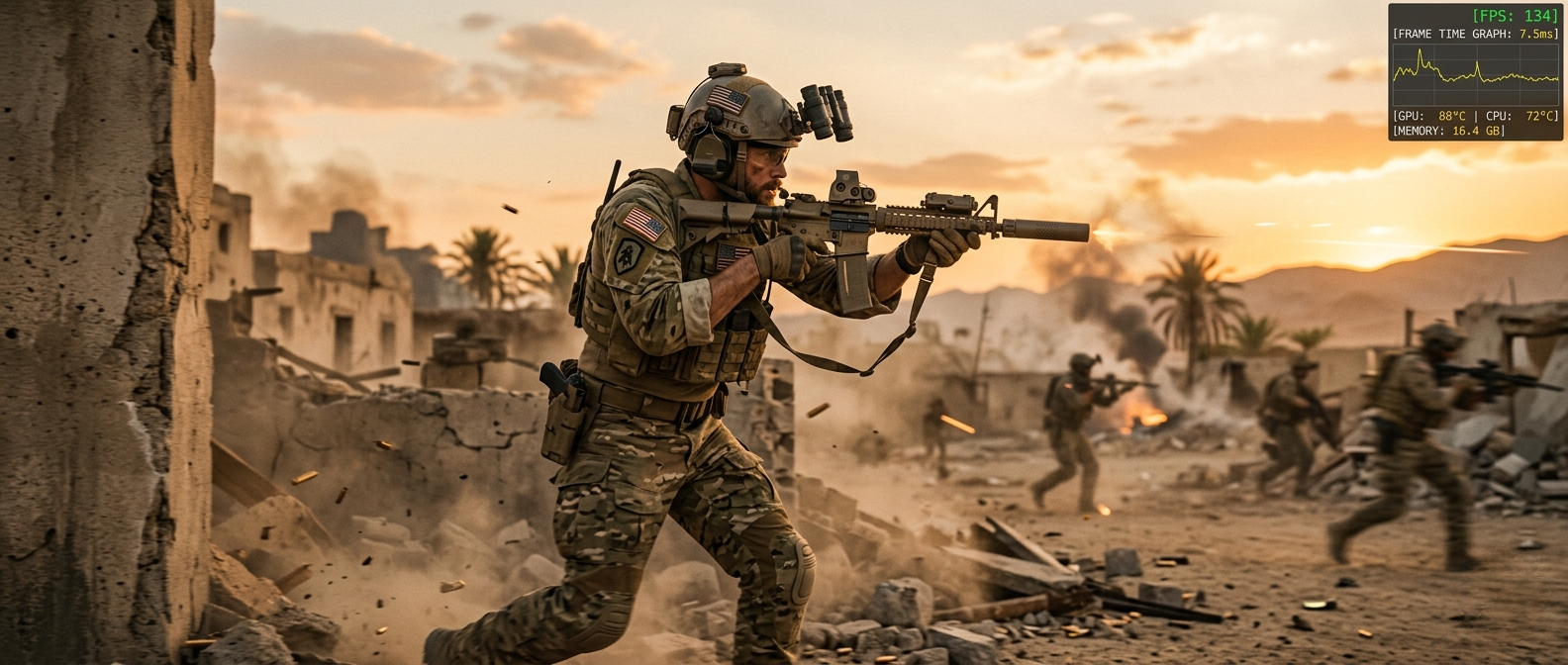

Delta Force’s 2026 season update brought overhauled maps, reworked destruction physics, and — for a lot of players — a fresh wave of stuttering and frame drops. Whether you’re on a budget build or a high-end rig, the default settings leave performance on the table. This guide walks through every meaningful tweak to fix fps drops delta force pc settings 2026 and keep your frame rate locked and smooth.
Why Delta Force Drops Frames in 2026
The Season 3 patch introduced large-scale particle effects tied to the new weather system and upgraded vehicle destruction. These are GPU- and CPU-heavy features that hit mid-range hardware especially hard. The engine also switched to a new shader compilation pipeline, which causes one-time stutters on first load — but misconfigured settings extend those stutters indefinitely.
The two biggest culprits:
- Shader pre-compilation not triggered at launch — causes micro-stutters mid-match
- Rendering resolution set to 100% with Ray Tracing on — tanks GPU headroom for minimal visual gain
Rust players face similar FPS issues
Step 1: Pre-Launch Fixes (Do These First)
Force Shader Pre-Compilation
Before adjusting any in-game settings:
- Open the Delta Force launcher
- Click Settings → Game Settings → Shader Pre-Compilation
- Set it to Full and let it run (takes 5–15 minutes depending on your GPU)
This eliminates the stutter spikes that look like FPS drops but are actually compilation hitches. Players who skip this step often spend hours chasing a settings problem that doesn’t exist.
Set Power Plan to High Performance
- Open Control Panel → Power Options
- Select High Performance (or Ultimate Performance if visible)
- For laptops: plug in and disable any battery-saver mode
This alone can recover 10–20 FPS on Ryzen 5000/7000 systems where the default power plan throttles clock speeds.
Update and Verify GPU Drivers
- NVIDIA: Use GeForce Experience or grab the latest driver from nvidia.com — version 572.x or later has Delta Force-specific optimizations
- AMD: Use Adrenalin 24.3.1 or later for RDNA 2/3 improvements
- Intel Arc: Driver 31.0.101.5590+ fixes the Arc A770 frame pacing issue
Step 2: In-Game Graphics Settings
Open Settings → Graphics. Work through these from top to bottom.
Display Settings
| Setting | Recommended Value |
|---|---|
| Display Mode | Fullscreen (not Borderless — adds input lag) |
| Resolution | Native (e.g. 1920×1080 or 2560×1440) |
| Refresh Rate | Match your monitor’s max rate |
| VSync | Off |
| Frame Rate Limit | Cap to your monitor Hz + 3 (e.g. 167 for 165Hz) |
Capping a few frames above your monitor refresh rate keeps the GPU loaded without overshooting and causing thermal throttle.
Rendering Resolution
This is the single highest-impact setting. At 1080p:
- 100% = full native render, maximum GPU load
- 85% = visible quality drop but large performance gain (~25%)
- 75% = noticeable blur, use only on budget GPUs
Recommended: 90–95% for 1080p/1440p. Looks nearly identical to 100% but frees up GPU headroom.
Key Graphics Settings
| Setting | Budget GPU | Mid-Range GPU | High-End GPU |
|---|---|---|---|
| Texture Quality | Medium | High | Ultra |
| Shadow Quality | Low | Medium | High |
| Effects Quality | Low | Medium | High |
| Vegetation Density | Low | Medium | High |
| Ambient Occlusion | Off | SSAO | HBAO |
| Depth of Field | Off | Off | Low |
| Motion Blur | Off | Off | Off |
| Ray Tracing | Off | Off | Reflections only |
| DLSS/FSR/XeSS | Quality or Balanced | Quality | Quality |
Turn motion blur off regardless of your hardware tier. It adds GPU overhead for an effect most competitive players disable anyway. In Delta Force’s fast-pace infantry mode, it actively hurts your ability to track targets.
Upscaling: DLSS, FSR, and XeSS
This is the biggest single win for most players trying to fix fps drops delta force pc settings 2026:
- NVIDIA (RTX 20 series and newer): Use DLSS 3.5 set to Quality mode. At 1080p this renders at ~720p internally and upscales — minimal visual difference, significant GPU savings. RTX 40-series can also enable Frame Generation for an additional 30–50% frame boost.
- AMD (RX 6000/7000 series): Use FSR 3.1 set to Quality. Also enables frame interpolation on RDNA 3.
- Intel Arc: Use XeSS set to Quality — noticeably better than FSR on Arc hardware.
- Older NVIDIA (GTX 10/16 series): Use FSR 2 (available even on NVIDIA) at Balanced mode.
Step 3: NVIDIA and AMD Control Panel Tweaks
NVIDIA Control Panel
Go to Manage 3D Settings → Program Settings → Delta Force:
| Setting | Value |
|---|---|
| Low Latency Mode | Ultra |
| Power Management Mode | Prefer Maximum Performance |
| Texture Filtering Quality | High Performance |
| Vertical Sync | Off |
| Shader Cache Size | Unlimited |
Enable NVIDIA Reflex in-game if you have a 20-series or newer card. It cuts input lag by 10–30ms and has zero FPS cost.
AMD Radeon Software
Under Gaming → Delta Force → Graphics:
- Radeon Anti-Lag: On
- Radeon Boost: Off (causes resolution scaling that conflicts with in-game upscaling)
- Image Sharpening: 30–50% (compensates for upscaling softness)
- Wait for Vertical Refresh: Off
Step 4: Windows and System-Level Fixes
Disable Xbox Game Bar and Overlays
Game Bar causes random FPS drops on some systems:
Settings → Gaming → Xbox Game Bar → Off
Settings → Gaming → Captures → Record in background → Off
Also disable the Steam overlay for Delta Force: right-click the game in Steam → Properties → uncheck “Enable Steam Overlay.”
Set CPU Priority in Task Manager
While Delta Force is running:
- Open Task Manager → Details
- Right-click
deltaforce.exe→ Set Priority → High
Do not set it to Realtime — that can destabilize Windows.
Check Thermals
Throttling from heat is invisible and mimics the exact symptom pattern of bad settings. Use HWiNFO64 or MSI Afterburner to monitor:
- CPU temp: Should stay under 90°C under load (under 80°C ideal)
- GPU temp: Should stay under 83°C
- GPU hotspot temp: Should stay under 100°C
If either spikes and you see FPS drops coincide, the problem is cooling, not settings.
Hardware Tier: Realistic FPS Expectations
After applying all the settings above:
Budget Tier
RX 6600 / GTX 1660 Super / RTX 3060 (8–12GB VRAM)
- 1080p, Medium settings, FSR Quality or DLSS Balanced
- Expected: 70–100 FPS in 64-player matches, 90–120 FPS in smaller modes
- Frame dips to 55–65 during large explosions are normal
Mid-Range Tier
RX 7700 XT / RTX 4070 / RTX 3080
- 1440p, High settings, DLSS/FSR Quality
- Expected: 90–130 FPS at 1440p, 130–160 FPS at 1080p
- Ray Tracing at Reflections-only adds 10–15 FPS overhead
High-End Tier
RX 7900 XTX / RTX 4080 / RTX 4090
- 1440p or 4K, Ultra settings, DLSS Quality + Frame Generation
- Expected: 140–180 FPS at 1440p native, 160–200+ FPS with Frame Generation at 1080p
- At 4K Ultra without upscaling: 80–110 FPS on RTX 4090
Quick Checklist Before Your Next Match
- [ ] Shaders pre-compiled (launcher setting)
- [ ] Power plan set to High Performance
- [ ] GPU drivers updated
- [ ] Fullscreen mode enabled (not borderless)
- [ ] VSync off, frame cap set
- [ ] DLSS / FSR / XeSS enabled at Quality
- [ ] Motion blur off
- [ ] Ray Tracing off (unless RTX 40-series with headroom)
- [ ] NVIDIA Reflex or AMD Anti-Lag enabled
- [ ] Steam/Discord overlays disabled
Still Dropping Frames? Check Your CPU Bottleneck
Delta Force is more CPU-intensive than most shooters due to the physics simulation. If your GPU usage sits below 90% while you’re dropping frames, you’re CPU-bottlenecked. Symptoms: frame drops happen specifically in crowded areas, during explosions, or when many players are on screen.
To fix fps drops delta force pc settings 2026 caused by CPU bottleneck:
- Lower Effects Quality and Vegetation Density — both are CPU-side calculations
- Reduce Max Soldier Count in graphics settings if available
- Ensure no background apps (Chrome, Discord video, OBS) are competing for CPU cores
- On Ryzen systems, enable Precision Boost Overdrive (PBO) in BIOS for a free 5–8% performance boost
The combination of shader pre-compilation, proper upscaling, and control panel tweaks resolves the majority of cases where players need to fix fps drops delta force pc settings 2026. Start with the pre-launch steps, apply the graphics settings for your tier, and use the FPS calculator to confirm you’re hitting expected numbers before diving deeper into system-level changes.